

Imagine telling your two children that you’re giving each of them $300,000. One receives cash. The other receives shares you bought years ago for $60,000. Both gifts are worth the same amount on the day you sign the paperwork. If both children need a down payment next spring, though, they may have very different amounts to spend.
That is where I would start a family wealth management conversation. Before choosing investments or deciding who gets what, I want to know what the money needs to do, who will make decisions, and what each person could actually spend after taxes. The answers can change which assets you transfer and when you transfer them.
At LBNS, the accountant’s contribution to wealth management is to put numbers beside those choices. Here are seven steps you can work through with your family, using the records you already have.
In this guide
1. Give your wealth management plan a job
What does successful wealth management look like to each generation? A parent might want to stay in her home even if she needs paid care. Her son might want to buy the family business. Her granddaughter might need help with college. Each goal has a different deadline, and the same dollar can only pay for one of them.
Write down the amount, timing, and priority of each commitment. “Help with college” becomes “contribute $10,000 each September for four years, provided our retirement reserve stays intact.” That gives a grandparent room to be generous and gives the student a figure to use when comparing schools. It also gives the family a way to revisit the promise if circumstances change.
I would close with one uncomfortable question. If your resources fall short, which commitment would you postpone first? It is easier to discuss that tradeoff around a kitchen table than during a hospital stay or a rushed property sale.
2. Build a balance sheet someone else can read
A family balance sheet names the owner, approximate value, debt, and location of the records for each significant asset. For investments held in taxable accounts, add the cost basis and the purchase date if known. For real estate, note the mortgage balance and who pays the carrying costs. For retirement accounts, record when you last checked the beneficiary form.
The gaps can tell you more than the total. Suppose a rental property is worth $600,000 and carries a $200,000 mortgage. The family has roughly $400,000 of equity before selling costs and taxes. It still needs cash each month for insurance, repairs, and debt payments. Someone reading only the property value could easily promise money that the household cannot access.
Date the balance sheet and put a source beside each figure. A brokerage statement, a loan payoff quote, and an owner’s rough estimate deserve different weight. Keep sensitive documents in a secure location. Give the appropriate person instructions for finding them without putting passwords or full account numbers in a family spreadsheet.
3. Compare what each generation keeps after tax
Return to the two $300,000 gifts. Assume the shares are in a U.S. taxable brokerage account, the parent’s adjusted basis is $60,000, and there is no adjustment for gift tax. If the recipient sells immediately for $300,000, the sale generally produces a $240,000 capital gain before selling costs. The sibling who received cash can spend it without first selling an appreciated investment.
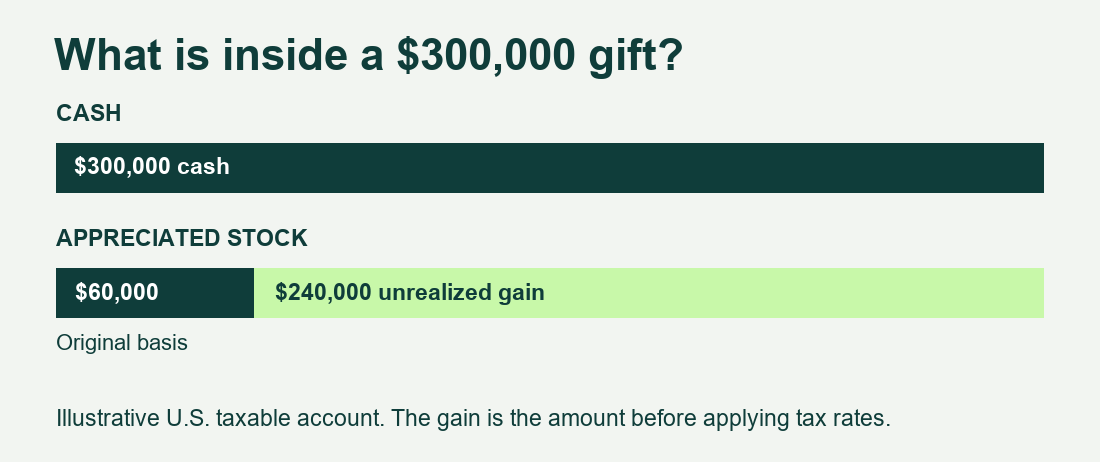
The $240,000 is the gain, not the tax bill. An accountant would need the recipient’s income, applicable tax rates, state of residence, and other gains or losses to estimate the tax. If one child needs cash soon and the other wants to keep the shares, a different division might suit both of them. Start by asking the children what they intend to do.
Timing also matters. Under U.S. federal rules, inherited property generally takes a basis tied to its fair market value at death, subject to exceptions. Gifted property follows different rules. For your next wealth management review, ask your accountant to compare three options: a gift, a sale, and an inheritance. Have your estate attorney review how each choice fits your documents. The IRS explains the distinctions in Publication 551, Basis of Assets.
There is a second question for the parent making the gift. A large transfer may require a federal gift tax return even when no gift tax is due. Give your preparer the transfer date, the value on that date, and the records supporting the original cost. Send copies of the basis records to the child who receives the shares. Years later, that child may need to explain a purchase made before they even had a brokerage account. See the IRS overview of estate and gift taxes.
4. Stress-test your wealth management plan against six months of bills
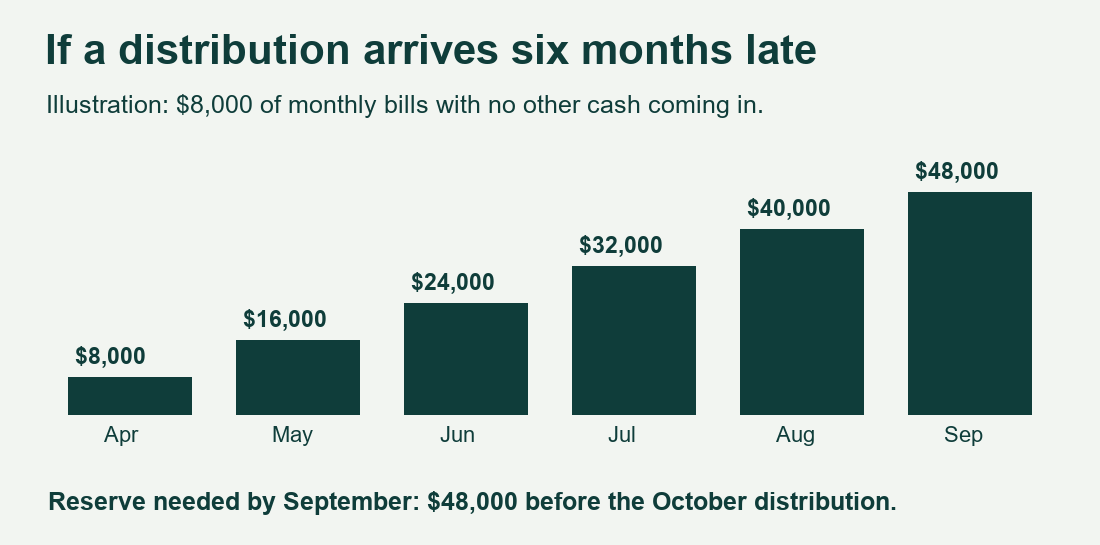
In a wealth management plan, the timing of a payment matters as much as its size. Draw up a twelve-month calendar of expected income and expenses. Include estimated taxes, property expenses, family support, and planned gifts. Mark income that could be delayed, such as a business distribution or the proceeds of a home sale.
Now take one payment off the calendar. If a $50,000 business distribution arrives in October instead of April, which bills come due in the meantime? Work out the largest cash shortfall month by month. That figure gives the family a reason for its reserve and a basis for deciding whether a gift can go ahead.
Run the same exercise for someone taking over. A surviving spouse may have enough assets on paper while lacking immediate access to the account that pays the mortgage. Ask the bank about its procedures and your attorney about the authority the spouse would need. Keep the answers with the cash calendar.
5. Work out who can run the family business
For business owners, wealth management includes three decisions about succession. Who can manage the company? Who will own it? What income will the retiring owner need? One child may be ready to manage employees while a sibling wants a financial interest and no operating role. Putting their expectations in writing helps everyone see where they agree.
Ask your accountant to model the first year under new management. Begin with ordinary operating cash flow. Deduct a market salary for the incoming manager, debt payments, necessary equipment purchases, and the proposed payments to the retiring owner. If the business runs short in a typical year, revisit the purchase terms before asking anyone to sign.
Then ask who could approve payroll on Friday if the owner became unavailable on Thursday. That question often leads to practical work the family can finish now, such as documenting approval limits or arranging a second authorized signer. Your attorney can translate the agreed ownership and decision rights into the appropriate agreements.
6. Give the next generation a rehearsal
A family wealth management meeting can start with a single account. Let the person who might inherit responsibility for that account walk through one task. Ask an adult child to find the insurance contact for the rental property or show a spouse how to locate the most recent tax return. Notice which parts still depend on one person’s memory.
Bring retirement accounts into the exercise. Request copies of the beneficiary designations on file with each custodian. Compare names and percentages with your intentions, including who should receive the account if the first beneficiary dies before you. Distribution rules for an inherited account depend on the beneficiary and the circumstances. The IRS guidance for retirement plan beneficiaries is a starting point for that conversation.
When wealth management spans borders, record where the owner lives, where the recipient lives, and where the asset is located. Share that information with advisers familiar with the relevant jurisdictions before moving money or changing ownership. A U.S. tax projection covers only part of a transfer that another country may also tax or require someone to report.
7. Put the next wealth management review on the calendar
An annual wealth management review works best with a short agenda. Bring the latest tax return, account statements, beneficiary confirmations, and the prior year’s action list. Compare actual spending with the cash forecast. Ask whether a marriage, death, relocation, new grandchild, or planned business sale changes an assumption. A major change is a reason to meet sooner.
Finish with a named person and a date for each decision. “Check the basis” becomes “I’ll request the original brokerage statements by March 15, and our accountant will use them to compare the gift and sale options.” Next year, the family can see what happened and why. That record is particularly valuable when a different generation takes the lead.
If you want a place to begin, bring LBNS one decision your family expects to face in the next year. It could be funding tuition, transferring shares, or stepping back from a business. We can help you compare the cash and tax consequences and identify questions to take to your other advisers. Contact LBNS to discuss your family’s wealth management plan.
